
Last updated: October 4, 2026
We all have days where nothing goes according to plan.
Maybe you dropped the ball on an important project, snapped at someone you love after a long day, burned dinner to a crisp, or just felt completely overwhelmed by the sheer volume of life.
In those moments, notice what your inner voice does. If you’re like most of us, your default response isn’t gentle. It sounds more like an internal drill sergeant: “Why can’t you get it together?” or “You always mess this up.”
We often hold a quiet, mistaken belief that beating ourselves up keeps us accountable. But harsh self-criticism doesn’t inspire growth—it just leaves us exhausted, defensive, and depleted. Self-compassion isn’t about making excuses or lowering your standards; it’s about giving yourself a steady foundation to stand on while you navigate the mess.
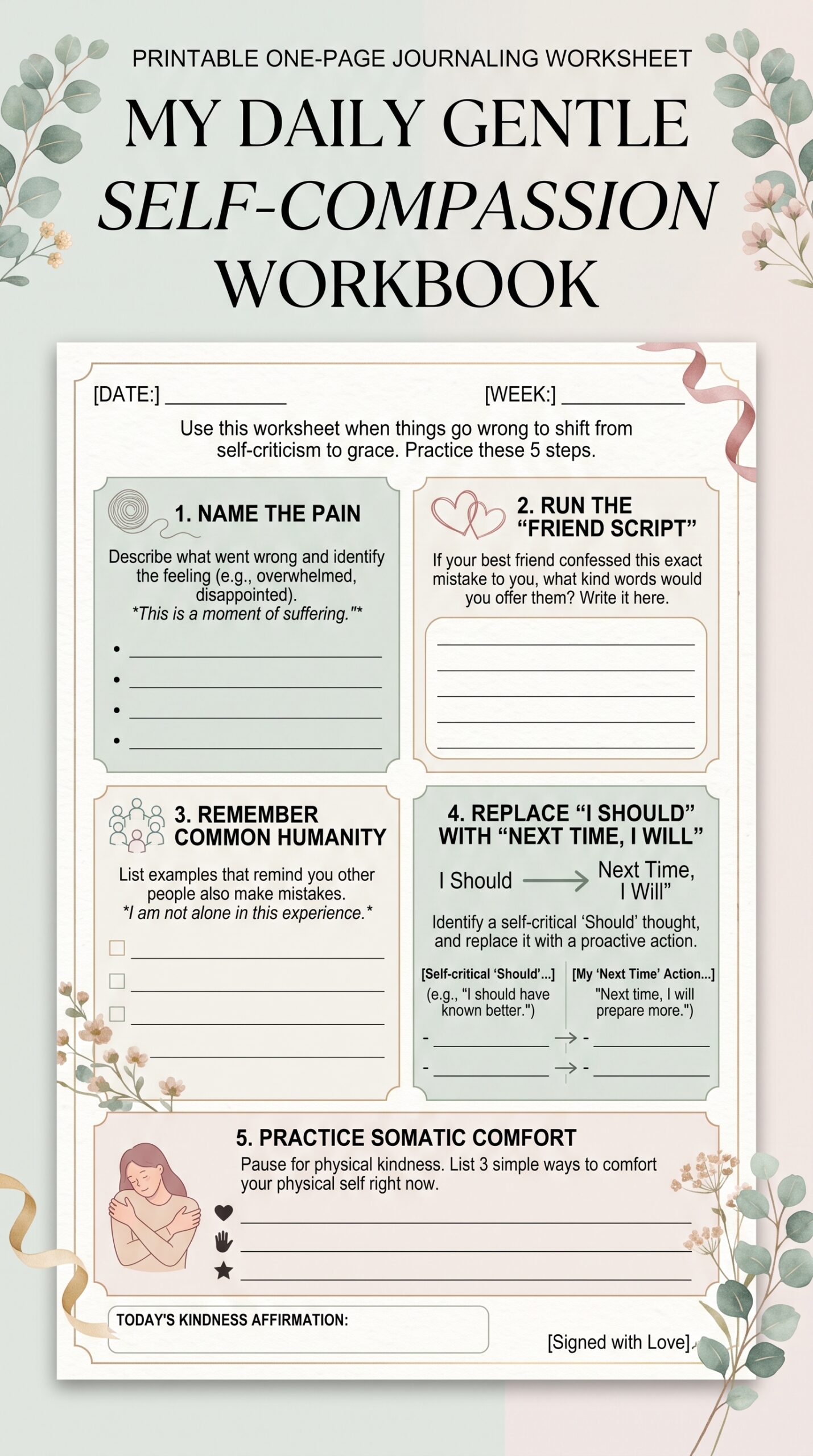
The next time things go sideways, use these five actionable tools to shift your internal dialogue from critique to grace.
1. Name the Pain Before Trying to Fix the Problem
When things go wrong, our instinct is to scramble into emergency mode: fix the problem, hide the mistake, or immediately analyze how we failed.
Before jumping into solution mode, pause and practice what psychologist Kristin Neff calls mindful awareness. Acknowledge the emotional weight of the moment simply and without judgment:
- “This is really hard right now.”
- “I’m feeling overwhelmed and disappointed.”
- “Oof. That hurt.”
Naming the feeling regulates your nervous system. You aren’t dramatizing the situation, and you aren’t minimizing it either. You are simply validating that having a hard day is difficult.
2. Run the “Friend Script” Check
When self-criticism takes over, we speak to ourselves using a tone and vocabulary we would never dream of directing at anyone else.
The next time you catch your inner critic spiraling:
- Identify the exact thought: “I’m such a failure for forgetting that deadline.”
- Apply the lens: Imagine your closest friend sitting across from you at the kitchen table, confessing that exact mistake with tears in their eyes. Would you tell them they’re hopeless? Would you list every other mistake they’ve made this month?
- Borrow your outer voice: Speak to yourself in the same cadence, tone, and logic you would offer them: “You’ve been juggling so much lately. Anyone would drop a ball under this kind of stress. It’s an honest mistake, and we can fix it.”
If you wouldn’t say it to someone you love, don’t accept it from yourself.
3. Tap Into “Common Humanity”
Self-criticism thrives on isolation. It convinces you that everyone else is managing life effortlessly while you alone are dropping plates.
Break that illusion by reminding yourself of common humanity:
- Mistakes, bad days, and setbacks do not make you an exception; they make you human.
- At this exact moment, thousands of other capable, well-meaning people are also feeling inadequate, frustrated, or behind.
When something goes wrong, swap “What is wrong with me?” for “This is part of the human experience.” It immediately diffuses shame by reconnecting you to everyone else doing their best in an imperfect world.
4. Replace “I Should Have” With “Next Time, I Will”
The word “should” is the critic’s favorite weapon. It locks you into the past—a place where you have zero power to change the outcome. Replaying what you should have anticipated or how you should have handled things only fuels regret.
Reclaim your agency by transforming retrospective judgment into forward-looking boundary setting:
- Instead of: “I should have known better than to agree to that.”
- Try: “Next time, I will give myself 24 hours before committing to a new project.”
- Instead of: “I shouldn’t have lost my temper.”
- Try: “Next time I feel my chest tightening, I will step out of the room for three deep breaths.”
This simple language pivot shifts you from self-punishment to proactive learning.
5. Offer Yourself Somatic Comfort
Your brain believes your body. If your jaw is clenched, your shoulders are hunched around your ears, and your breath is shallow, your brain will stay in fight-or-flight mode—making kind thoughts nearly impossible.
Physical warmth and gentle pressure signal safety to your nervous system:
- Place one or both hands over your heart or on your chest.
- Wrap your arms around your shoulders in a grounding embrace.
- Drop your shoulders away from your ears, unclench your jaw, and let out an audible sigh.
Pair that physical reset with a short, anchor phrase: “I am safe right now. We will handle this one step at a time.”
The Takeaway
Giving yourself grace doesn’t mean you don’t care about doing well; it means you care enough about yourself to offer support when things are tough.
You don’t have to transform your inner voice overnight. Self-compassion is a muscle built in tiny increments. Today, if things go wrong, just catch yourself midway through a harsh thought and soften the edges just five percent. That quiet shift is where real resilience begins.
Over to you: What is your default reaction when plans fall apart, and which of these five tools resonates most with where you are today? Share in the comments below—I’d love to hear from you.
About Lauren
I’m so incredibly grateful you’re here to share this journey with me. Let’s explore what it means to live authentically, one day at a time.